What Is the Munsell Color System?
The munsell color system is a standardized method for describing and organizing color using human visual perception rather than pigments or digital formulas. Built around three measurable attributes—hue, value, and chroma—the munsell color system provides a clear, consistent structure for discussing color in art, design, manufacturing, soil analysis, education, and scientific research. Its practical approach makes color predictable, repeatable, and universally understood.
Developed more than a century ago, the munsell color system still influences modern color models because its hierarchy reflects how people intuitively perceive color differences. As digital and physical industries demand greater accuracy, the munsell color system remains a reliable benchmark across disciplines.
Why the Munsell Color System Matters
The munsell color system matters because it bridges the gap between subjective color perception and precise color communication. Artists use it to mix pigments accurately. Designers use it to maintain brand consistency. Soil scientists rely on it to classify environments. Manufacturers use it to control quality at scale. Because the munsell color system aligns with human perception, it simplifies the process of describing subtle color changes.
Without a consistent system like this, teams working across geography, industries, or lighting conditions would struggle to identify colors reliably. The system removes ambiguity and supports repeatable results.
The Three Components of the System
The munsell color system organizes colors using three perceptual dimensions:
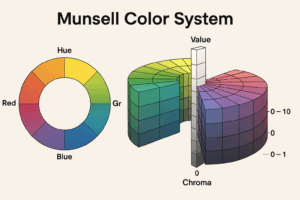
Hue refers to the category of color such as red, yellow, green, blue, or purple. The system arranges hues around a circular scale, grouping related families together in evenly spaced steps.
Value measures the lightness or darkness of a color. Higher values are lighter, while lower values are darker. This vertical axis helps users pinpoint precise degrees of brightness.
Chroma expresses the strength or saturation of a color. A low-chroma color appears muted or grayish, while high chroma feels vivid and intense. This horizontal axis expands outward from neutrals.
This three-part structure makes the munsell color system easy to navigate even for beginners.
The History Behind the Munsell Color System
Albert H. Munsell—an American painter, inventor, and color theorist—developed the munsell color system in the early 1900s to bring more order to how artists talk about color. His goal was to create a scientific, perceptually balanced model that matched how the human eye distinguishes visual differences.
In 1915, he published the Munsell Book of Color, which formalized these ideas and offered physical samples for consistent comparison. Today, variations of this system appear in digital imaging, food inspection, forensics, and agricultural science, reflecting its lasting influence.
Hue Organization and Structure
Hue in the munsell color system is arranged around a circle containing five principal hues—Red, Yellow, Green, Blue, and Purple. Between each pair, intermediate hues create a total of ten major groups. These groups divide further into 100 precise steps.
This design makes the munsell color system extremely granular yet simple to navigate. Because each step represents a visible shift, users can identify and categorize hue variations without guesswork.
Value in the Munsell Color System
Value runs vertically from 0 (pure black) to 10 (pure white). Every hue can exist at multiple values, which helps describe how light or dark any given color appears. Most real-world colors fall between these extremes, making the munsell color system a reliable way to compare brightness across materials or environments.
This scale is crucial in industries like soil science, food quality control, painting, and photography, where the difference between a lighter and darker sample may carry important meaning.
Chroma and Color Intensity
Chroma expands horizontally from a neutral gray center. As chroma increases, colors become purer and more intense. Each hue has its own potential chroma range, because some naturally reach higher saturation than others. For example, yellows and oranges often exhibit strong chroma values, while blues and purples may have lower maximum chroma in certain mediums.
The munsell color system treats chroma as relative, offering standardized comparisons across different color families.
Applications in Art and Design
Artists use the munsell color system to mix pigments accurately and create predictable results. Because the model separates hue, value, and chroma, painters can adjust one attribute without unintentionally altering another. Designers adopt the system to maintain brand consistency, choose harmonious palettes, and compare materials in various lighting conditions.
Interior designers rely on it for coordinating paint, textiles, and furnishings. Graphic designers use its logic when shaping digital palettes. The munsell color system helps ensure visual coherence across all creative work.
Applications in Science and Industry
The munsell color system plays a major role in scientific classification. Soil scientists use Munsell charts to evaluate moisture content, organic matter, and landscape conditions. Food inspectors reference it when assessing ripeness or detecting discoloration. Forensic investigators use it during evidence documentation.
Manufacturers across textiles, plastics, and coatings use the munsell color system to maintain consistency between production batches. By aligning color with measurable attributes, the system reduces error and improves quality control.
Comparing the Munsell System to Other Color Models
Many color models serve different purposes, but the munsell color system remains distinct because it is perceptually uniform. RGB and CMYK depend on digital or print technologies. HSL and HSV offer simplified digital approximations. The CIE system is mathematically rigorous but less intuitive to artists or designers.
The munsell color system uniquely blends scientific accuracy with visual logic, making it accessible to both creative and technical users.
Munsell Notation and Practical Usage
A typical Munsell notation looks like 5R 4/14, describing a color’s hue (5R), value (4), and chroma (14). This notation eliminates ambiguity when communicating across teams, industries, or continents.
To use the system effectively:
• Identify the hue family
• Determine the value using the vertical scale
• Match chroma intensity using the samples
With practice, users can classify any color with speed and precision.
Benefits and Limitations of the System
The munsell color system offers several significant benefits. It organizes colors visually and logically, reduces miscommunication, and supports accurate reproduction across industries. It adapts well to environmental sciences, creative work, and manufacturing.
However, no system is perfect. Because it originally relied on printed color samples, physical charts may fade or vary. Some digital interpretations may not match original samples precisely. And because color itself is influenced by lighting, perception can shift in unusual conditions.
Still, the munsell color system remains one of the most trusted frameworks for color classification.
References
- https://www.munsell.com
- https://www.nature.com/articles
- https://www.color.org